BACKFLOW PREVENTER TESTING IN LOS ANGELES
Annual testing requirements, NFPA 25 standards, and LAFD Regulation 4 compliance for backflow preventers on commercial fire sprinkler systems in LA.
Last updated:
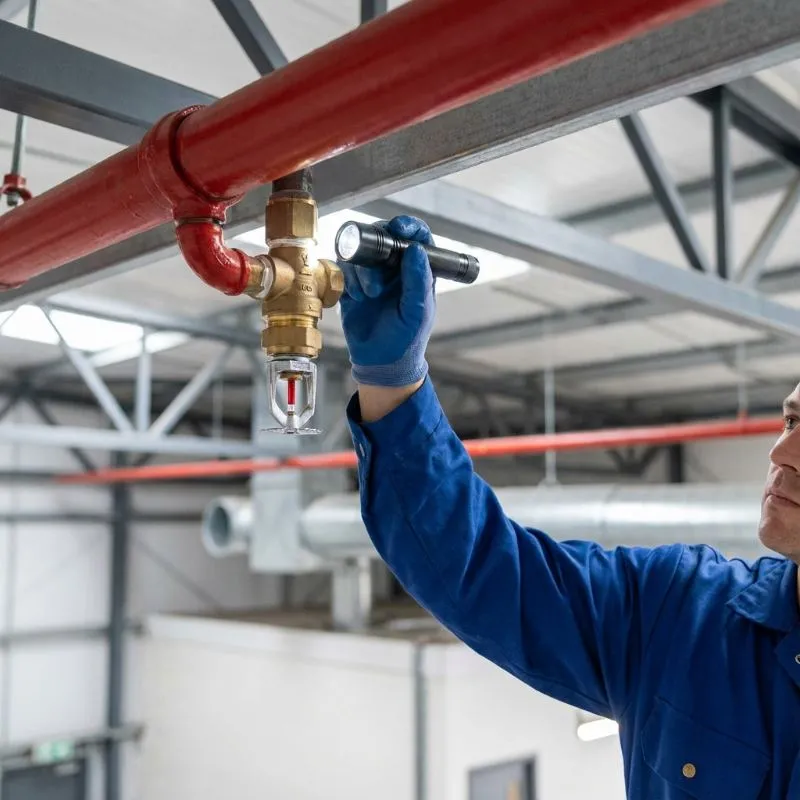
Annual testing requirements, NFPA 25 standards, and LAFD Regulation 4 compliance for backflow preventers on commercial fire sprinkler systems in LA.
Last updated:
A backflow preventer is a mechanical assembly installed on the water supply line feeding a fire sprinkler system. Its purpose is to protect the public drinking water supply from contamination. Water in a fire sprinkler system can become stagnant over time, accumulating sediment, bacteria, and pipe corrosion byproducts. If pressure conditions in the building ever cause water to flow backward — from the sprinkler system into the city water main — a backflow preventer stops that contaminated water from reaching the municipal supply.
Every commercial building in Los Angeles with a fire sprinkler system is required to have a backflow prevention assembly on the sprinkler supply line. The assembly must be tested annually to verify it still functions correctly. This testing requirement comes from multiple authorities: NFPA 25 (the fire sprinkler inspection standard), the Los Angeles Department of Water and Power (LADWP), the LA County Department of Public Health, and LAFD Regulation 4 (the City of Los Angeles annual fire life safety testing requirement).
Two types of backflow prevention assemblies are commonly found on fire sprinkler systems in Los Angeles commercial buildings. The type installed depends on the hazard level of the connection and the local water authority's requirements.
A double check valve assembly uses two independently operating spring-loaded check valves in series. If the first check valve fails to seal, the second check valve provides backup protection. DCVAs are used on standard wet fire sprinkler systems where no chemical additives are present in the sprinkler piping. They are the more common type found in typical commercial buildings such as offices, retail spaces, and warehouses. DCVAs can be installed in a vault below grade or in a mechanical room and do not discharge water during normal operation.
A reduced pressure zone assembly (also called an RP or RPZ) has two check valves plus a hydraulically operated relief valve between them. If both check valves fail, the relief valve opens to drain the water to atmosphere rather than allowing it to flow back into the city main. RPZ assemblies provide a higher level of protection and are required on fire sprinkler systems that use antifreeze solutions, chemical additives, or any connection classified as a high-hazard cross-connection. Because the relief valve can discharge water if the assembly malfunctions, RPZ assemblies must be installed where drainage is available — never in a below-grade vault without adequate drainage.
NFPA 25 — the Standard for the Inspection, Testing, and Maintenance of Water-Based Fire Protection Systems — requires annual testing of all backflow prevention assemblies on fire sprinkler systems. The annual sprinkler system inspection includes the backflow preventer test as part of the overall fire protection system evaluation.
In Los Angeles, LADWP independently requires annual backflow preventer certification. Property owners receive notification from LADWP when their backflow preventer test is due. Test results must be submitted to both LADWP and the LA County Department of Public Health. Failing to complete the annual test can result in notices of non-compliance and, in extreme cases, disconnection of water service.
A certified backflow prevention assembly tester performs the annual test using a calibrated differential pressure gauge kit. The test procedure involves the following steps:
The entire test typically takes 15 to 30 minutes per assembly. Buildings with multiple fire sprinkler risers may have a backflow preventer on each riser, requiring separate tests for each.
After testing, the certified tester completes a standardized test report documenting the assembly's make, model, serial number, size, location, and the measured pressure readings for each check valve and relief valve. The report indicates whether the assembly passed or failed. In Los Angeles, this report must be submitted to LADWP and the LA County Department of Public Health within the required timeframe. When the backflow preventer test is performed as part of an LAFD Regulation 4 annual inspection, the test documentation is also included in the Reg 4 compliance filing with the LAFD Fire Prevention Bureau.
LAFD Regulation 4 requires annual fire life safety system testing for applicable commercial buildings in the City of Los Angeles. Backflow preventers are included as part of the fire sprinkler system testing component of Regulation 4. During the annual Reg 4 inspection, the backflow preventer test verifies that the building's fire sprinkler water supply is properly protected against cross-contamination — a requirement that overlaps with LADWP's independent annual certification.
Coordinating both requirements into a single annual inspection is standard practice. A licensed C-16 fire protection contractor handles the overall Reg 4 fire sprinkler inspection while a certified backflow tester (often the same contractor or a subcontracted specialist) performs the backflow preventer test. This approach ensures both the LAFD and LADWP requirements are satisfied in one visit, reducing disruption to the building and avoiding duplicate scheduling.
Backflow preventers are mechanical devices with moving parts that wear over time. Annual testing catches problems before they become compliance violations or contamination risks. The most common issues found during testing include:
When a backflow preventer fails its annual test, the assembly must be repaired and retested before it can be certified as compliant. Most failures are repairable — a qualified technician can replace worn check valve discs, clean or rebuild the relief valve, flush debris from the valve body, and replace damaged O-rings or springs. After repair, the assembly is retested using the same differential pressure gauge procedure to confirm it now meets the required specifications.
If the assembly is too corroded or damaged for cost-effective repair, it must be replaced entirely. Replacement involves shutting down the fire sprinkler system water supply, removing the old assembly, installing a new one of the correct type and size, and performing an initial test and certification. Property managers should coordinate replacement scheduling carefully to minimize the time the fire sprinkler system is out of service — a fire watch may be required during the work.
For commercial property managers in Los Angeles, the most efficient approach is to schedule backflow preventer testing as part of the annual LAFD Regulation 4 fire life safety inspection. This way, the backflow test, sprinkler inspection, fire alarm testing, and all other Reg 4 components are handled in a single coordinated visit. The fire protection contractor ensures that all test reports — including the backflow preventer certification — are properly filed with LAFD, LADWP, and the County Department of Public Health.
Keep track of your LADWP notification letters, as the water department sends annual reminders when backflow preventer certification is due. Even if your Reg 4 inspection has a different anniversary date, the backflow test performed during that inspection can satisfy the LADWP requirement as long as the test report is submitted on time. Your fire protection contractor can help coordinate the timing to avoid gaps in certification.
Backflow preventers on fire sprinkler systems in Los Angeles must be tested annually. NFPA 25 requires an annual forward-flow test to verify check valve and relief valve operation. LADWP also requires annual certification with test reports submitted to the water department and the LA County Department of Public Health. LAFD Regulation 4 includes backflow preventer testing as part of the annual fire life safety compliance inspection.
The two main types are the double check valve assembly (DCVA) and the reduced pressure zone assembly (RPZ). DCVAs use two independently operating check valves and are common on standard wet sprinkler systems. RPZ assemblies add a relief valve between the two check valves and are required for higher-hazard connections such as systems with antifreeze loops or chemical additives. Both types must be tested annually by a certified tester.
A certified tester connects a differential pressure gauge kit to the test cocks on the assembly. The tester measures the pressure drop across each check valve to confirm it holds against backpressure without leaking. On RPZ assemblies, the relief valve is also tested. The test takes approximately 15 to 30 minutes per assembly, and results are recorded on a standardized report submitted to LADWP and the LA County Department of Public Health.
Backflow preventers must be tested by a certified backflow prevention assembly tester holding a valid certification from an approved organization such as ABPA or the USC Foundation for Cross-Connection Control. For fire sprinkler system backflow preventers tested under LAFD Regulation 4, the testing is typically coordinated by a licensed C-16 fire protection contractor as part of the overall annual fire life safety inspection.
If a backflow preventer fails its test, the assembly must be repaired or replaced and retested before it can be certified. Common failure points include worn check valve seats or discs, fouled relief valves on RPZ assemblies, debris preventing proper seating, and corrosion restricting valve movement. After repair, the assembly is retested to confirm it meets specifications. LADWP tracks overdue certifications and may issue notices of non-compliance.
Yes. LAFD Regulation 4 requires annual testing of all fire life safety systems in applicable Los Angeles commercial buildings, and backflow preventers on fire sprinkler systems are included. The test is typically performed as part of the annual sprinkler system inspection. Documentation is included in the Regulation 4 compliance filing submitted to the LAFD Fire Prevention Bureau.
LA Fire Compliance handles backflow preventer testing as part of your annual LAFD Regulation 4 inspection. Certified testing, proper reporting to LADWP and LAFD, and retesting coordination — all in one visit.